
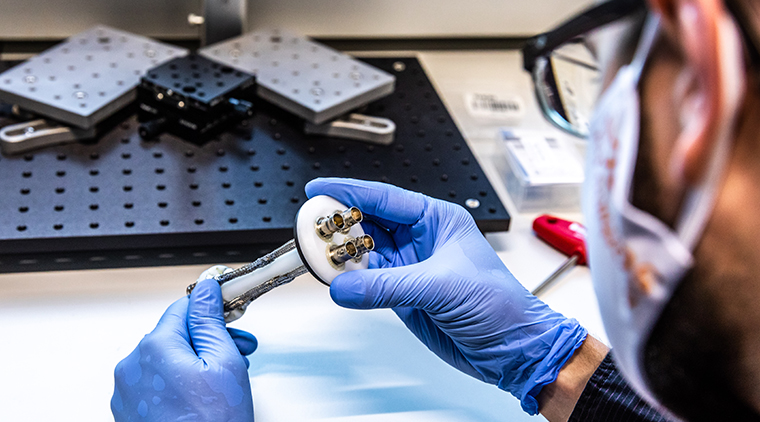
Chemistry & Materials at ISTA comprises theoretical and experimental approaches. Groups in chemistry take advantage of the NMR facilities available at ISTA.
Experimental chemistry groups conduct research at the interface of organic chemistry and materials science, with a focus on nanoscience and supramolecular chemistry (Klajn); in synthetic organic chemistry at the interface with materials science, focusing on heterogeneous photocatalysis using organic and inorganic semiconductors (Pieber); on adaptive molecules and materials through non-orthogonal stimuli (Stricker); and on enzyme engineering to enable non-native chemical transformations (Reisenbauer).
Groups on the interfaces to biochemistry are interested in the physico-chemical aspects of protein dynamics and interactions (Schanda), self-organization of protein systems (Loose), how the interplay between transcription factors and the histone code influences genome regulation (Michael), or structural DNA nanotechnology (Praetorius).
Experimental research is carried out in the area of physical chemistry such as functional nanomaterials (Ibáñez), materials electrochemistry (Freunberger), working on the interface of soft matter physics, materials science and living materials (Fernandez-Rico, Palacci), or quantum electrodynamics (Baykusheva). The Venkataraman and the Sunko groups are working on the interface to and with physics. The Venkataraman is collaborating with synthetic chemists and theoretical solid state physicists to understand matter at the nanoscale.
On the theory side, research areas include work on the intersection of soft matter physics, biology and physical chemistry, to study physical mechanisms underlying biological processes at the nanoscale (Saric), or work on computational protein design (Praetorius).
COMPLETE CHEMISTRY & MATERIALS RESEARCH GROUP DETAILS ON ISTA’S MAIN SITE:
-
- Ultrafast Quantum Phases and Spectroscopy
DENITSA BAYKUSHEVA - Soft and Biofabricated Materials
CARLA FERNANDEZ-RICO - Materials Electrochemistry
STEFAN FREUNBERGER - Functional Nanomaterials
MARIA IBáñEZ - Supramolecular Chemistry
RAFAL KLAJN - Self-Organization of Protein Systems
MARTIN LOOSE - Genome Regulation and Biological Timekeeping
ALICIA MICHAEL - Materiali Molli
Jérémie PALACCI
- Ultrafast Quantum Phases and Spectroscopy
- Catalysis & Synthetic Methodology
Bartholomäus PIEBER - Biomolecular Design
FLORIAN PRAETORIUS - Biocatalysis and Protein Engineering
JULIA REISENBAUER - Computational Soft and Living Matter
ANDELA SARIC - Biomolecular Mechanisms from Integrated NMR Spectroscopy
PAUL SCHANDA - Photoresponsive Adaptive Molecules & Materials
FRIEDRICH STRICKER - Symmetry Probes of Quantum Matter
Veronika SUNKO - Single-Molecule Physics and Chemistry
LATHA VENKATARAMAN
You can also find more information on upcoming Talks, Events and Courses on the dedicated Physics, Chemistry and Maths site physicsandbeyond.